 This past Wednesday (St. Patrick's Day) when Grumpy hosted a senior citizens' auto tour of the Skagit Delta bulb fields, we spotted this white bird feeding in a plowed field. He(She?) was about a quarter mile away, but with the fine camera that the Grand Mother blessed me with for my last birthday, these 200% digitally-zoomed (full optical zoom on the Sony) clearly show that the bird is a swan. But what kind?
When we first spotted this bird, we weren't even sure it was alive; rather we suspected it was merely a piece of white plastic fluttering in the breeze. After watching it for awhile, Grumpy became certain that, indeed, it was alive. But even then we suspected it would likely be a Snow Goose, as we had seen a large flock of them earlier.

It wasn't until Grumpy digitally-zoomed in to these cropped excerpts that he was sure of the identification that this was a swan. But what kind?
Grumpy took four shots and the last one, shown here on the left, with the swan's head and black beak showing, indicates that this is a Tundra Swan. I believe that this feature (black beak) is the distinguishing characteristic of the Tundra. Grumpy saw these up in Alaska in 1991. It is unfortunate that this fourth photo is blurry -- I should have taken another two or three when his head was up; one of them might have been as clear as the first three.

This is what a Tundra Swan looks like in flight (from the Internet).


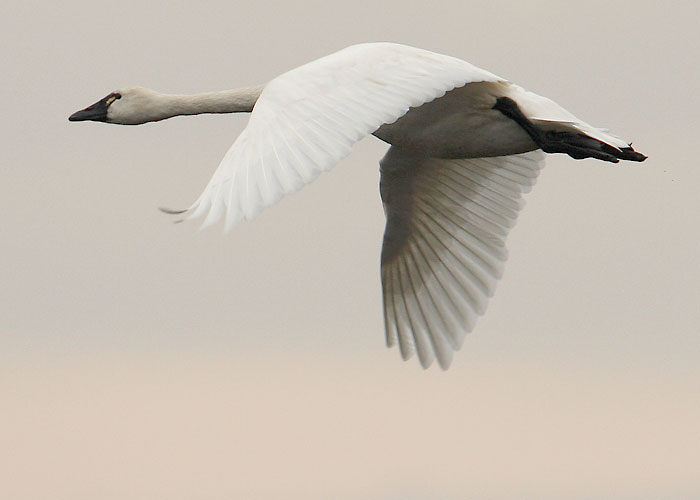
An e-mail from one of my "Sassy" offspring brought me up short on my hasty ID of this Swan as a Tundra. She pointed me to a website that reminded me of the very subtle features which differentiate between the Tundra a Trumpeter Swans.
ReplyDeleteAll I saw as the black beak (and I was thinking the Trumpeter had a yellow beak!) and jumped to the conclusion that what I saw was a Tundra.
Correct I.D.: either Tundra or Trumpeter Swan; Grumpy should have ended the post with "What kind?"